Last updated November 1, 2026
If you want a milder root for tea and soup, buy American ginseng; if you prefer a stronger, more bitter taste, buy Korean ginseng. Heil Ginseng grows only American ginseng, in Edgar, Wisconsin, and does not sell Korean ginseng. American ginseng and Korean ginseng are two different species. American ginseng is Panax quinquefolius. Korean ginseng, also sold as Asian ginseng, is Panax ginseng. They differ in where they grow, how the roots are prepared, how they taste in a cup or a pot, and what they cost. We grow American ginseng in Edgar, Wisconsin, where the Heil family has farmed since 1953.
Our American ginseng, grown in Wisconsin:
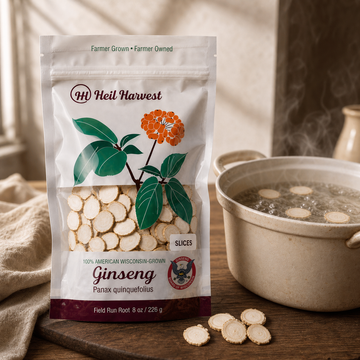

American vs Korean ginseng at a glance
| Feature | American ginseng | Korean (Asian) ginseng |
|---|---|---|
| Plant species | Panax quinquefolius | Panax ginseng |
| Where it is grown | Farmed in Wisconsin, Canada and China; the listing should name the origin | Sold as Korean or Asian ginseng; the listing should name the growing country |
| Common forms | Dried whole root, slices, tea bags, powder, and fresh root in season | White (dried root) and red (steamed, then dried) |
| Taste | Milder: earthy and a little bitter at first, then gently sweet | Usually stronger and more bitter; red ginseng is darker with a slightly caramel taste |
| Cooking and tea | Tea, soup, broth, congee and chicken soup | Traditional in samgyetang, the Korean whole-chicken soup |
| What sets the price | Age, root size, bag size, fresh or dried | Age, root size, origin and whether it is red or white |
All Heil Ginseng roots are American ginseng grown in Wisconsin. We do not sell Korean ginseng.
Chinese, Asian, Panax and red ginseng: what the names mean
Is Chinese ginseng the same as American ginseng?
Chinese ginseng points to a place, so the name alone does not give you the species. A root sold under that name can be Panax ginseng or American ginseng grown in China, so read the species name on the label. In Chinese, American ginseng is called 西洋参 (xi yang shen) and 花旗参 (hua qi shen).
What is Asian ginseng, and is it the same as Korean ginseng?
Asian ginseng is the common name for Panax ginseng. Korean ginseng is Panax ginseng sold under a Korean name, and red or white describes how the root was prepared. American ginseng is a different species, Panax quinquefolius.
Is Panax ginseng the same as American ginseng?
No. Panax is the genus both plants belong to. Panax ginseng is the Asian species. Panax quinquefolius is the American species, and it is the one Heil Ginseng grows in Wisconsin.
Is Korean red ginseng the same as Panax ginseng?
Korean red ginseng is usually Panax ginseng that has been steamed and dried. Panax ginseng names the species, and red names the preparation. White ginseng generally means dried root without that steaming, so red and white say nothing about the species or the origin.
What is ginseng called in Korean?
인삼 (insam) is the Korean word for ginseng, and it names Panax ginseng. American ginseng is a different species, Panax quinquefolius.
Where each one is grown
American ginseng is farmed in Wisconsin, in Canada and in China. Our farm is in Marathon County, Wisconsin, a major growing area. When a package says only American ginseng, you do not yet know the country, so look for a stated growing location. Korean ginseng works the same way: the name points toward Korea, and the listing should still name the growing country.
Taste and how to cook with each
Korean ginseng usually tastes stronger and more bitter. Red ginseng, which is steamed before drying, has a darker, slightly caramel taste. American ginseng is milder: earthy and a little bitter at first, then gently sweet. How much root you use and how long it steeps change the cup.
American ginseng suits tea, soup, broth and congee, and slices or tea bags are the simplest place to start. See how to make ginseng tea, our taste guide and a full ginseng chicken soup recipe.
Samgyetang is a whole small chicken stuffed with rice and simmered in one pot. It is traditionally made with Korean ginseng. American ginseng works in it too and gives a more earthy, gently bitter broth. The chicken soup recipe includes a samgyetang-style version.

Price: what you pay and why
For American ginseng, price follows age. A garden kept for five seasons takes two more years of weeding, mulching and watching than a three-year garden, and some plants are lost along the way. Root size matters, bigger bags cost less per pound, and fresh root costs less per pound than dried because about three pounds of fresh root dry down to one. Red ginseng adds a steaming step, and origin affects any ginseng's price.
| Our American ginseng | Good for | From |
|---|---|---|
| Tea bags, 30 count | The easiest cup | |
| Dried slices, 8 oz | Tea and soup with nothing to cut | HK$1,188.00 HKD |
| 3-year whole root, 8 oz | Everyday tea and soup, sliced at home | HK$1,188.00 HKD |
| 5-year whole root, 8 oz | Gifts, and the oldest roots we grow | HK$1,588.00 HKD |
See today's price per pound for every age and bag size. Whichever kind you buy, compare the same form and age by net weight.
Which should you buy?
- Choose American ginseng for a milder taste, for everyday tea and soup, or if you want to know the farm it came from.
- Choose Korean red ginseng for a darker, usually stronger taste.
- Follow the recipe if a dish names one kind.
We compare the two by taste and use here, not by health effects. For tea, read the best ginseng for tea. To compare sellers, read how to choose a brand.
How to buy either kind
- Read the species name: Panax quinquefolius is American, Panax ginseng is Korean or Asian.
- Find the growing country on the package or listing, and ask if it is missing.
- Check the form: dried white root, red ginseng, fresh root, slices, tea bags or powder.
- Check the age and the net weight, and compare similar bags by weight.
- Ask for a lot code or records that connect the bag to its harvest.
For American ginseng, our buyer's checklist goes deeper on judging roots, and the root age guide compares the ages we grow.
What we grow at Heil
We grow American ginseng on our own farm in Wisconsin. The Heil family has farmed and grown ginseng here since 1953, across four generations. We harvest three-, four- and five-year roots and sell seasonal fresh roots as well as dried products. We do not sell Korean ginseng or mix Canadian- or Asian-grown roots into our crop. Meet the Heil family farm.
American vs Korean ginseng questions
What is the main difference between American and Korean ginseng?
They are different species of the same genus. American ginseng is Panax quinquefolius and Korean ginseng is Panax ginseng. They also differ in where they are grown, how they are commonly prepared, how they taste in the kitchen and what they cost.
Is Panax ginseng the same as Korean ginseng?
Panax ginseng is the species name for what is sold as Korean or Asian ginseng. The word Korean points to where it is grown, so check the listing for the growing country. American ginseng is also a Panax, which is why the genus name alone does not tell you which one you have.
Is American ginseng the same as Asian or Chinese ginseng?
No. Asian ginseng is Panax ginseng, and American ginseng is Panax quinquefolius. Chinese ginseng points to a place, and China farms American ginseng too, so read the species name on the package.
Can I use American ginseng in Korean recipes?
Yes. Samgyetang works with American ginseng slices or a small soaked root, and the broth comes out more earthy. Our chicken soup recipe includes a samgyetang-style version.
Which one should I buy?
Buy the species your recipe or label names, from a seller who states the origin, the age and the net weight. If you want American ginseng, start with tea bags or slices, or choose a whole root by age.
Related: What is American ginseng? · What does ginseng taste like? · Where to buy American ginseng · Ginseng tea bags
